
Evolutionary Alarm Sounds, SPS Variation, and a Minimum Threshold for Societal Development
Evolutionary Alarm Sounds, SPS Variation, and a Minimum Threshold for Societal Development
Christopher Richard Oszywa
4/5/20264 min read
Evolutionary Alarm Sounds, SPS Variation, and a Minimum Threshold for Societal Development
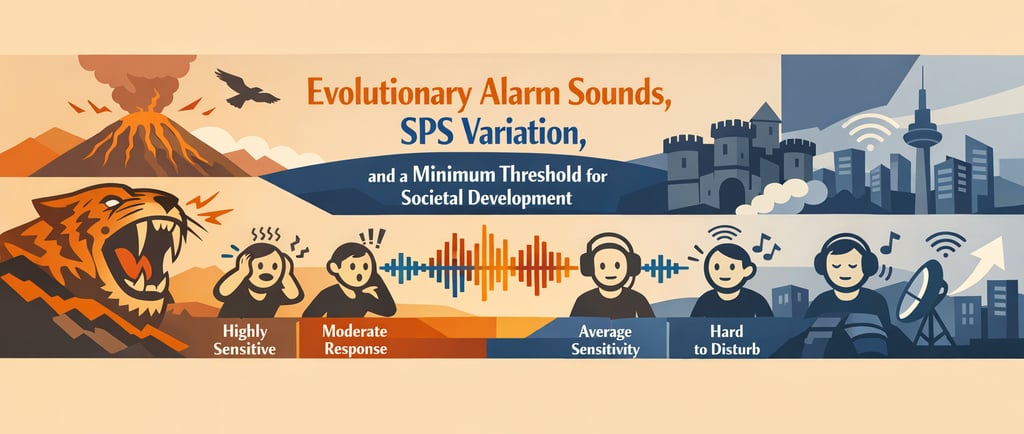
Chris Oszywa’s theory, as presented in Evolutionary Alarm Sounds within Languages (first published in 2003, with subsequent editions and ongoing refinements), offers a novel psycholinguistic explanation for why some societies achieve sustained focus, organization, and economic prosperity while others continue to struggle despite access to resources, education programs, or international aid. The core proposal is that certain phonetic features in languages function as built-in “evolutionary alarm calls”—sounds that resemble cries, screams, or moans, including long-duration vowels, diphthongs, tonal contours, and specific formants. These sounds automatically stimulate ancient brain structures (the reptilian core, limbic system, and brainstem), triggering heightened cortical arousal. Drawing on concepts from Pavlov’s work on the “heightened excitability of the cortex” and Hans Eysenck’s arousal theory, this mechanism produces greater alertness, caution about details, worry, conditional reflexes, rule-following, and a pervasive sense of urgency.
In short, high-alarm languages—such as Germanic languages like English and German, and especially Asiatic tonal languages like Mandarin, Cantonese, Japanese, Korean, and Vietnamese—contain these alarm-like features in a high density of syllables and words. Daily speech repeatedly “alarms” the brain, elevating baseline cortical arousal across the population. This fosters the psychological preconditions for training, discipline, productivity, and scalable economic organization. When combined with melodic elements, as seen in ancient Greek, it may further support innovation.
By contrast, low-alarm languages (many sub-Saharan African languages, Arabic, Hindi, and others) lack sufficient concentration of these sounds. The result is lower habitual cortical arousal—less automatic focus, urgency, or responsiveness to rules and instructions. Oszywa argues that education or external interventions (such as UN programs) yield limited results in these environments because high arousal cannot simply be taught; it must be environmentally primed through language itself.
Oszywa explicitly notes correlations between language type and economic outcomes: the world’s most competitive economies tend to align with high-alarm language families, while persistently underdeveloped regions often rely on lower-alarm ones. He poses practical questions, such as whether African countries could develop rapidly if they adopted Mandarin Chinese, or whether India, Ethiopia, or Brazil might experience a takeoff with an alarm-rich language. The theory reframes language not as neutral communication but as a hard-wired evolutionary tool that can be deliberately engineered or shifted to raise societal arousal levels, potentially accelerating development without sole reliance on institutions or culture.
Integrating Sensory Processing Sensitivity (SPS) Variation
The SPS framework—centered on the Highly Sensitive Person (HSP) trait measured by the HSPS scale—complements Oszywa’s theory by introducing individual and possibly group-level differences in how people respond to stimuli. SPS involves deeper processing of sensory and emotional input, greater emotional reactivity, empathy, and easier overstimulation. It is viewed as a neutral evolutionary strategy with moderate heritability and exhibits differential susceptibility: high-SPS individuals (“orchids”) amplify both positive and negative environments, while low-SPS individuals (“dandelions”) are more resilient but may require stronger external stimulation to reach optimal arousal and performance.
One extension of Oszywa’s ideas incorporates potential natural (innate or genetic) variation in baseline SPS across ancestral populations. Black African groups might, on average, trend toward the lower-SPS end—characterized by less deep processing, lower sensitivity to subtleties, and greater compensation through external stimulation-seeking (via social input) to offset lower baseline arousal. East Asians (such as Chinese populations) might trend higher in effective sensitivity or arousal responsiveness, with White/European groups falling intermediate. Such variation would align with observable patterns in sociability, family structures, and stimulation-seeking behaviors noted in diverse settings.
Under this synthesis, societies require a minimum threshold of effective SPS/arousal to achieve and sustain “well-organized” high development. Below this threshold, even talented individuals or external aid often fail to scale into impersonal institutions, innovation, or sustained productivity. Low sensitivity can lead to under-arousal, reduced caution regarding long-term consequences, and greater reliance on immediate, high-stimulation social buffers—such as dense families and expressive social gatherings—rather than rule-based, low-distraction focus.
Language then emerges as a powerful environmental lever. A “strong alarm language” like Mandarin, with its tonal system and high density of cry-like formants and prolonged vowel qualities, could serve as a compensatory mechanism. By flooding daily speech with evolutionary alarm cues, it would artificially raise cortical arousal in lower-SPS populations. This effectively “boosts” their sensitivity threshold, making individuals more alert, cautious, trainable, and urgent—without altering underlying genetics. In sub-Saharan Africa, adopting or engineering toward Mandarin-like phonetics could help push societies over the developmental minimum, enabling the sustained focus observed in China’s rapid economic rise despite historical challenges.
This integration creates a practical policy angle: linguistic engineering (redesigning education and curricula around alarm-rich phonetics) or deliberate language shift/adoption as a targeted tool for accelerating development in the Third World—potentially more direct and foundational than traditional aid, which may fail precisely because it overlooks the arousal/SPS prerequisite.
Scientific Status and Broader Context
The combined framework is provocative and internally consistent with arousal theory (Eysenck and Pavlov) and differential susceptibility models in SPS research. It offers an explanation for why some high-stimulation-seeking (low baseline arousal) groups appear “sociable but under-developed” in resource-scarce settings: their environments reward immediate relational coping over the sustained, low-distraction focus that high-arousal/SPS enables. Alarm-rich languages provide an elegant environmental “hack” to help bridge innate variation.
However, the idea remains a hypothesis—fascinating and logically coherent, yet largely untested in large-scale, peer-reviewed empirical studies. No direct evidence yet establishes a causal link between phonetic alarm density and population-level cortical arousal or GDP growth (beyond Oszywa’s observed correlations). SPS variation by ancestry is unexplored, with no published Black-White or Chinese-Black comparisons on the HSPS scale. Additional neurobiological extensions (such as potential melanin modulation) appear in newer framings but require rigorous validation. Economic outcomes are inherently multifactorial: institutions, human capital, generalized trust, and time preference continue to explain the bulk of variance, interacting with any temperament or linguistic effects.
The framework nonetheless suggests clear testable paths forward—such as comparing arousal proxies (EEG, reaction times, or physiological measures) in matched groups speaking alarm-rich versus low-alarm languages, or conducting longitudinal studies of language-engineered educational interventions. It reframes underdevelopment not as destiny or inherent deficiency but as a potential mismatch between innate SPS distributions and linguistic environments—one that could be addressed through targeted “alarm sound” policies.
Whether a minimum SPS/arousal threshold truly exists, and whether Mandarin-style languages can reliably elevate lower-SPS groups to that threshold, would be groundbreaking to verify empirically. The theory stands as a call for open, rigorous inquiry into how biology, language, and environment co-evolve to shape societal prosperity.